Sound Healing Retreat Bali: A Deeper Resonance Than Traditional Meditation?
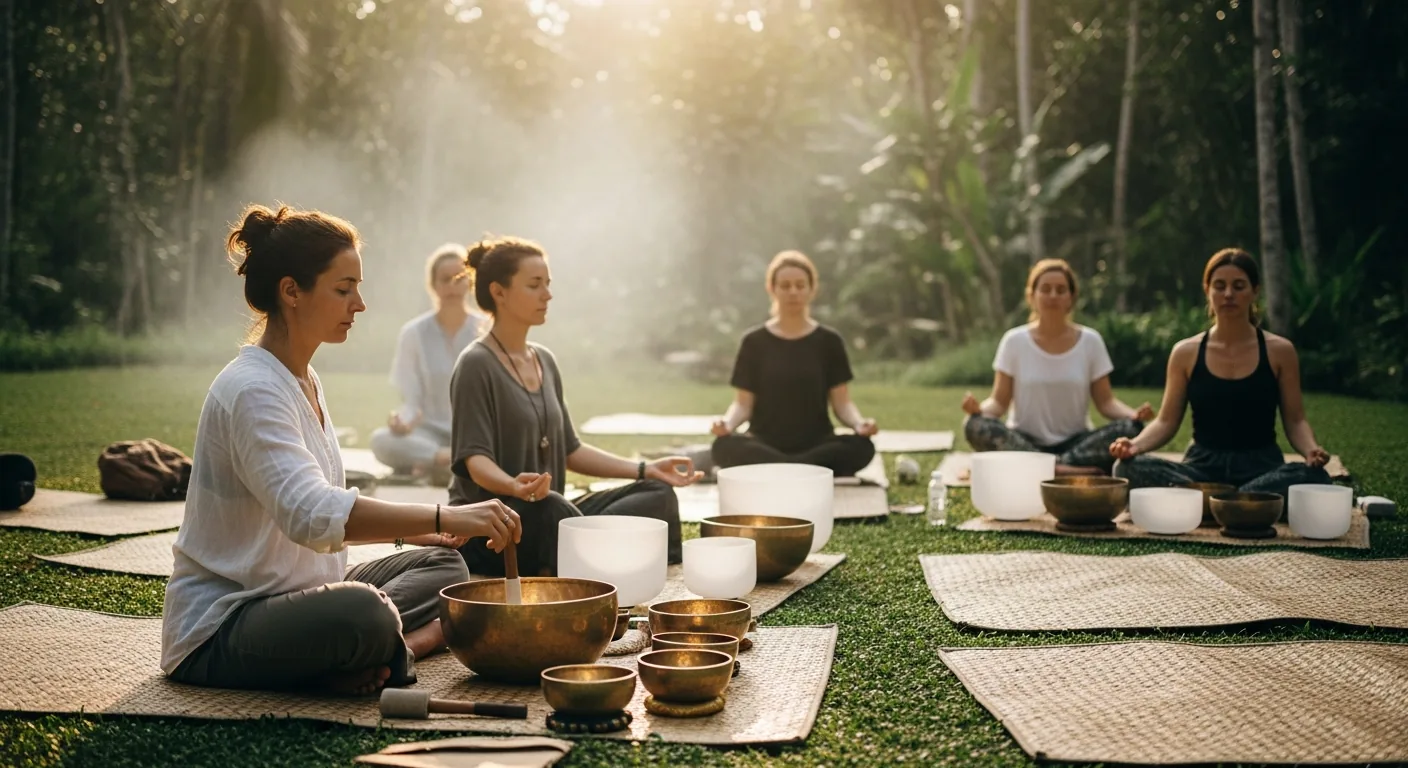
The air in Ubud hangs thick and sweet with the scent of frangipani and slow-burning incense. Geckos chirp a syncopated rhythm against the distant hum of a gamelan rehearsal. It is a place where the veil between the tangible and the ethereal feels particularly thin. Yet, for the modern traveler arriving from the perpetual alert of city life, the inner landscape is often anything but serene. The mind, conditioned by a relentless barrage of information, resists the quietude. This presents a fundamental question for those seeking restoration in Bali: does one wrestle the mind into submission through the silent discipline of traditional meditation, or is there a more direct path—one that uses vibration to recalibrate the very cells of the body?
The wellness lexicon is dense with options, from silent Vipassanā retreats to immersive sound baths. For the discerning individual, the choice is not merely about preference but about efficacy. The central inquiry is this: in the unique spiritual ecosystem of Bali, does a meticulously curated sound healing experience offer a more accessible and profound state of release than the venerable, silent practices that have been its contemplative backbone for centuries? This is not a question of which is superior, but which is more resonant for the contemporary seeker in this precise moment, in this specific place. We explore the distinction, comparing the ancient art of stillness with the vibrational science of a sound healing retreat Bali.
The Foundations: Tracing the Roots of Silence and Sound
To understand the divergence, one must first look to the origins. Traditional meditation, particularly the forms prevalent in Southeast Asia, has a documented lineage stretching back millennia. Vipassanā, which translates to “insight,” is one of the oldest Buddhist meditation techniques, with its methodology detailed in texts like the Satipatthana Sutta, composed around 500 B.C. The practice is an austere, rigorous observation of reality as it is, a silent dissection of mind and matter. Its arrival in Bali was part of the larger Hindu-Buddhist influence that began around the 1st century A.D., shaping the island’s unique spiritual identity. Centers like the Bali Usada Meditation Centre, founded by Balinese master Merta Ada in 1993, carry this tradition forward, teaching a specific technique focused on healing the “unharmonious mind.”
Sound healing, conversely, is a practice with a more disparate and ancient global history. The concept of sound influencing matter and consciousness is not new. Ancient Greek physicians used musical instruments like the lyre to treat patients, believing specific harmonies could restore balance to the body. In the Himalayas, the use of Tibetan singing bowls, crafted from a seven-metal alloy, is thought to date back to at least the 12th century, used by monks to aid meditation. The gong, a central instrument in a modern gong meditation bali, has an even deeper history, with evidence of its use in Chinese culture as early as 4000 B.C. for ceremony and communication. The contemporary practice of the “sound bath” synthesizes these ancient tools, applying them with a modern understanding of acoustics and physiology.
The Neurological Landscape: How the Brain Responds to Stillness vs. Vibration
The effects of these two modalities on the human brain are distinct and measurable. Decades of research, much of it pioneered by figures like Dr. Richard Davidson at the University of Wisconsin-Madison, have mapped the neurological changes from long-term meditation. The practice is known to strengthen the prefrontal cortex—the seat of executive function—and decrease activity in the Default Mode Network (DMN), the brain’s “chatter” center associated with self-referential thought and anxiety. Experienced meditators can consciously generate high-frequency gamma waves, associated with peak concentration and heightened states of consciousness. This is a process of active, disciplined training; the practitioner is the agent of change. See also: explore Contact.
A bali sound healing session operates on a different principle: brainwave entrainment. This is the phenomenon where the brain’s own electrical cycles synchronize with the frequency of an external stimulus, such as the rhythmic pulse of a singing bowl or the sustained resonance of a gong. The facilitator is the agent, using precisely chosen frequencies to guide the listener’s brain into desired states without conscious effort from the participant.
- Alpha Waves (8-12 Hz): Induced by calmer instruments, this state is associated with light relaxation and daydreaming, a bridge from the active Beta state.
- Theta Waves (4-7 Hz): The goal of most sound baths. This is the state of deep meditation, REM sleep, and heightened creativity. A Paiste planetary gong, for instance, can produce frequencies around 1.618 Hz, which can rapidly induce a theta state.
- Delta Waves (0.5-4 Hz): The slowest brainwaves, linked to deep, dreamless sleep and profound cellular regeneration. Sustained, low-frequency drones from large gongs or crystal bowls can encourage this state.
The late Dr. Mitchell Gaynor, a New York oncologist, was a notable proponent, using crystal bowls in his practice and documenting their ability to shift patients from a stressed sympathetic nervous system response (fight-or-flight) to a relaxed parasympathetic state (rest-and-digest).
The Bali Context: Where Ancient Practices Meet Modern Wellness
Ubud has long been the island’s spiritual heart, a crucible for both traditional and contemporary wellness practices. The path of silent meditation is well-established here. A 10-day silent Vipassanā retreat at a dedicated center might cost a participant between $600 and $900 USD, an all-inclusive price for lodging, food, and instruction, funded by donation. These are demanding, structured immersions requiring participants to rise before dawn and meditate for over 10 hours a day. See also: Facilitators Team pricing.
In the last decade, however, the landscape has diversified significantly. The rise of the ubud sound bath has been meteoric. Venues like The Pyramids of Chi, which opened in 2017, were built specifically to optimize acoustic resonance, offering daily sessions for around 350,000 IDR (approx. $25 USD). The iconic Yoga Barn, a fixture since 2007, hosts multiple sound healing events weekly, from a singing bowl ceremony bali to crystal bowl meditations, often drawing crowds of over 100 people per session. This accessibility—both in terms of cost and commitment—has made sound healing a primary entry point for many visitors seeking a taste of Bali’s restorative energy without the rigors of a silent retreat.
A Comparative Analysis: Effort, Accessibility, and Desired Outcomes
The choice between these modalities often comes down to an individual’s capacity, intention, and prior experience. A silent retreat demands immense internal effort, while a sound bath asks only for receptivity. One is an act of doing; the other, an act of being. To clarify the distinctions, consider the following comparison: See also: Sound Healing Retreat Bali Sacred About.
| Feature | Traditional Meditation (e.g., Vipassanā) | Sound Healing (e.g., Gong Bath) |
|---|---|---|
| Required Effort | High. Requires sustained focus, discipline, and mental fortitude to observe thoughts without engagement. | Low. The primary requirement is to lie down, remain still, and allow the sounds to permeate. |
| Barrier to Entry | Moderate to high. The “monkey mind” can be a significant obstacle for beginners, leading to frustration. | Very low. Accessible to anyone, regardless of prior meditation experience. The sounds provide an anchor for the mind. |
| Primary Mechanism | Cognitive self-regulation. Training the prefrontal cortex to quiet the Default Mode Network. | Brainwave entrainment and somatic resonance. Using external frequencies to shift brain state and release physical tension. |
| Typical Session Duration | Can be short (20 minutes daily) or long-form (10+ hours/day on retreat). | Typically 60-90 minutes for a group session. Private sessions can be longer. |
| Tangible Sensation | Often subtle. Sensations are observed internally, from breath to fleeting thoughts. | Highly physical. Participants often feel direct vibrations in the body, a sensation of floating, or see colors. |
| Ideal For… | Individuals seeking long-term mental discipline, self-awareness, and a structured path of insight. | Those seeking immediate stress reduction, release from creative blocks, or a non-cognitive entry into a meditative state. |
Expert Perspectives: Facilitators on the Front Lines in Ubud
To move beyond theory, we consulted with practitioners who navigate these modalities daily. I Wayan Suta, a fifth-generation Balinese healer and lead facilitator at Sound Healing Retreat Bali Sacred, explains the difference through a local lens. “In Balinese philosophy, we have *sekala* (the seen world) and *niskala* (the unseen world). Traditional meditation is a journey you take into *niskala* with your mind as the only map. It is a powerful but difficult path. A singing bowl ceremony bali is different. The sound creates a bridge. It brings the vibration of *niskala* into the seen world, into your bones and your blood. Silence asks you to find the stillness within. Sound brings the stillness *to* you.”
This explains why many find their first profound meditative experience not in silence, but in sound.
Curating Your Bali Wellness Itinerary: Integrating Sound and Silence
The most sophisticated approach to wellness in Bali is not an “either/or” proposition but a synthesis. Sound and silence are not opposing forces but complementary ones. A well-designed itinerary can leverage the strengths of each to create a more integrated experience. For those planning a visit, consider a structured progression: See also: explore Home.
- Begin with an Ubud Sound Bath: Upon arrival, attend a 60 or 90-minute group sound bath to recalibrate your nervous system after travel. This passive experience helps quiet the initial mental static and acclimates you to the island’s energy.
- Deepen with a Thematic Ceremony: Seek out a dedicated singing bowl ceremony bali or a crystal alchemy session. These are often more focused than a general sound bath, designed to work on specific energetic centers or intentions.
- Integrate with Silent Practice: Use the state of clarity and calm achieved through sound work as a foundation for a personal, silent meditation practice. You may find it significantly easier to sit in stillness after a vibrational “cleansing.”
- Consider a Private Session: For targeted work, a private gong meditation bali can be exceptionally powerful. Facilitators can tailor the session to your needs, using specific instruments to address energetic blockages. These sessions typically range from $100 to $180 USD per hour.
- Consult with Experts: Engage with experienced facilitators. A quality sound healing retreat bali will offer consultations to help you understand which modalities will best serve your goals, creating a program that is both restorative and transformative.
Your Invitation to Vibrational Resonance in Bali
Ultimately, the path to inner quietude is personal. While traditional meditation offers a time-tested map for the mind, sound healing provides a direct, somatic experience of tranquility. It is a potent modality for the modern traveler, offering a way to bypass the analytical mind and access a deeper state of being.
At Sound Healing Retreat Bali Sacred, our programs are designed by experienced facilitators who understand this delicate interplay. We utilize a curated collection of instruments, including 18th-century Himalayan singing bowls and precisely tuned planetary gongs, to guide you toward profound states of rest and insight. Our retreats integrate sound, breath, and stillness in the serene heart of Ubud.
Explore our signature sound healing retreat in Bali. View upcoming retreat dates or contact our concierge to design a private immersion tailored to your intentions.
Office: Jalan Sunset Road No. 88, Kuta, Badung, Bali 80361
Phone: +62 (811) 394-14563
Email: [email protected]